Glass Cases and Gentle Coercion: Reading the Shop Windows of Bentham
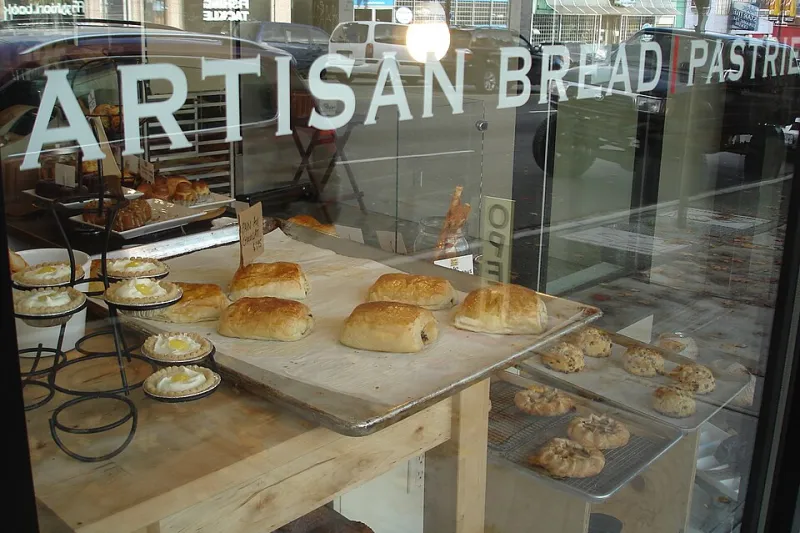
Photo: Vancouver Bites! from Vancouver, Canada, CC BY-SA 2.0, via Wikimedia Commons
Winter in Bentham is a season of glass. The bakery window fogs at the edges, the deli counter catches the low afternoon light, and the farm-shop shelves arrange themselves into little altars of jam and cheese. I have spent a week walking from one to the next, pretending to be a serious food writer and actually behaving like a moth with a debit card.
Jeremy Bentham, the philosopher whose surname the town happens to share, is best known for the panopticon: a prison designed so that inmates could never be sure whether they were being watched. The point was invisible authority. The modern shop window is the same idea, only nicer. You are not being watched by a guard; you are being watched by a tray of custard tarts. And, like the prisoner, you adjust your behaviour. You slow down. You pat your pocket. You go in.
The pastry case as a benevolent inspection tower
Every shop owner I spoke to had a version of the same confession: placement is not an accident. In one bakery, the owner told me the first tray at eye level is the audition. Croissants sit higher because their shape reads from the pavement; sausage rolls sit lower because they are a practical purchase, not a fantasy. The cake stand goes nearest the door on grey days. 'Nobody buys a slice of Victoria sponge at 9am,' she said. 'But they like knowing it is there. It makes the place feel generous.'
That is the trick of a good display. It does not shout. It reassures. A window full of identical buns says nothing; a window with one tray of buns, a stack of paper bags and a handwritten card says: someone is in the back, paying attention. The panopticon works because you cannot see the guard. The bakery window works because you can imagine the baker.
The bakery window: theatre at three o'clock
Go at 3pm in November or December, when the light turns the glass into a soft-focus filter and the last sausage rolls look like relics. This is when the display is at its most persuasive. The last three mince pies are pushed to the front, not because they are the best but because they are nearly gone. Scarcity does the work. A full tray says plenty; a nearly empty tray says you might miss out. This is the panopticon in reverse: the display watches your fear of missing out.
I asked one owner whether she ever rearranges the window to make people buy more. She laughed. 'I rearrange it so people can see what is left,' she said. 'But yes, the best things go at eye level. And the things that need eating today go by the till.' That is not manipulation; it is hospitality with a spreadsheet.
The deli counter and the side-eye
Deli counters are more subtle. There is no fogged glass, no tray of buns. There is a slab of cheese, a fan of crackers and a small jar of something dark and sticky. The owner of one counter told me the best placement is the one that looks like a mistake. 'If a jar of chilli jam is exactly beside the cheddar, people feel seen,' she said. 'They think, that would be nice. They do not think, I have been sold to.'
The till is the final inspection tower. Quince paste, oatcakes, a tiny box of fudge, a bag of local coffee. You queue, you look, you add. The deli knows you have already decided to buy something. The only question is whether you leave with one thing or three. I left with three.
Farm-shop shelves and the long game
Farm shops are less panopticon, more National Trust gift shop with better cheese. The shelves are arranged by mood: local honey at waist height, chocolate mice at child height, chutney near the cheese, candles near the till. The lighting is warm. The signage is handwritten. The whole place says: you are not in a supermarket; you are in a barn with taste.
One farm-shop manager told me that the biggest impulse buy is not chocolate. It is the thing you can take to someone else's house. 'People buy a jar of honey or a bag of coffee because it feels like a small gift,' she said. 'Even if they are going home to an empty flat.' That is the winter truth of these displays: they are selling comfort, not just calories.
What the windows are really selling
A shop window cannot follow you home. But it can follow you down the street. The best displays in Bentham do not try to trap you; they try to slow you down. They offer a small, local, defensible indulgence. A mince pie from the bakery. A wedge of cheese from the deli. A bar of chocolate from the farm shop. The panopticon is not a prison here. It is a pastry case, and we are willing inmates.
A surrender guide for winter 2026
If you are going to be tempted, be tempted well. Set a budget of £6 to £10, walk a loop of the town, and let one window win. These are the displays most worth surrendering to this winter:
- The bakery window at 3pm, when the light is low and the last tray is out. Buy one thing you did not plan to buy.
- The deli cheese-board station. Ignore the cheese for a moment and look at the extras: quince paste, chutney, oatcakes. That is where the meal is.
- The farm-shop local chocolate shelf. Look for a bar made within a reasonable drive of Bentham, not a luxury brand you could buy anywhere.
- The sweet-shop pick-and-mix. This is the purest panopticon of all: a wall of jars, a paper bag and the quiet pressure of not taking too long.
- The market stall with loose nuts and dried fruit. Buy a small bag for the walk home. It counts as fresh air.
The trick is not to resist every window. It is to notice which one is doing the tempting. Then decide whether you want to be tempted. Most of the time, in Bentham, in December, the answer is yes.