Biscuit Mechanics: A November Gingerbread Walk Through Bentham
Mid-November is gingerbread weather in Bentham. The pavements are damp, the light leaves early, and every bakery counter seems to have grown a tray of something spiced. This is not a Christmas shopping guide. It is a small field survey: a handful of shops and market stalls, four kinds of gingerbread, and a set of entirely made-up engineering criteria that happen to work rather well when you are standing outside with a paper bag.
The aim is simple. Find the gingerbread that best survives a November walk, the one that deserves a mug of tea, and the one that should stay on the plate until you are sitting down. Call it biscuit mechanics. Call it an excuse to buy four things and eat them slowly. Either way, it makes for a good Saturday.
The test method
Every gingerbread on this route gets marked against four things. Snap is the sound and feel of the break: a clean crack is good, a shatter is messy, and a bend is a warning. Crumb is about texture: tender and slightly chewy is the target, claggy is not. Spice should lead with ginger, with a warm hum behind it rather than a punch in the throat. And the icing-to-biscuit ratio is exactly what it sounds like: enough icing to be a treat, not so much that you are essentially eating a small roof tile.
The final category is dunking. A biscuit can be delicious and still fail the mug test. That is not a criticism. Some things are for sitting down, not for suspending over a brew.
First stop: the soft traybake
Start where the route is easiest: a bakery counter with a traybake cut into generous squares. The soft ginger traybake is the quiet hero of November. It does not snap. It does not pretend to. What it does is give you a sticky top, a tender crumb and a spice level that feels like a blanket rather than a bonfire.
This is the one to buy if you are walking no further than the nearest bench. It pairs beautifully with tea because it is already halfway to a pudding. The icing-to-biscuit ratio is generous but not silly, usually a thin smear or a light dusting rather than a full royal-icing incident.
Dunking verdict? Poor. It will slump into the mug and leave you fishing. Eat it first, then drink.
Second stop: the classic gingerbread man
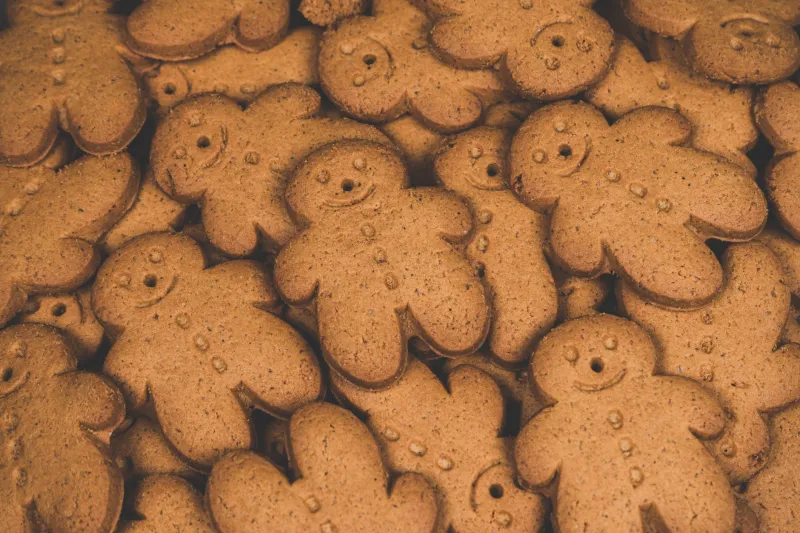
The classic man is where things get competitive. A good one should have a clean snap at the arm and a neck that holds together under mild pressure. The neck is the structural weak point. Anyone who has lost a gingerbread head into a hot chocolate knows this.
Around Bentham this month, the best versions are the ones that taste of dark sugar and ginger rather than only sweetness. The icing should be a detail, not the main event: a few buttons, a smile, maybe a cuff. When the icing is too thick, the first bite is all sugar and the second bite is a lecture in regret.
The classic man is a decent walker. It survives a coat pocket. It does not survive being crammed into a rucksack under a flask. Treat it with a little dignity and it will get you to the next stop.
Third stop: iced shapes and the ratio problem
Iced stars, hearts and trees look lovely in the window. They are also the most variable gingerbreads on the counter. Some are thin, crisp and properly spiced. Others are essentially a sugar delivery system with a biscuit underneath.
The test here is the edge. Break off a plain corner first. If the biscuit tastes of ginger and butter, the icing has something to sit on. If the plain corner tastes of nothing much, the icing is doing all the work. A good iced shape should be eaten in two stages: admire it, then bite through the middle where the ratio is most honest.
These are not the best dunkers. Royal icing does not melt gracefully. It cracks, slides and leaves a slick on top of your tea. Save them for the walk home, when you can eat them properly and not worry about looking refined.
The load-bearing ranking
If the question is which gingerbread can bear the weight of a proper dunk, the ranking is clear enough.
- The thin, crisp ginger biscuit. Best snap, best dunk, best chance of surviving the walk. Buy two.
- The classic gingerbread man. Good all-rounder, moderate dunking risk, high nostalgia value.
- The soft ginger traybake. Excellent with tea, hopeless in it. A sitting-down biscuit.
- The heavily iced shape. Beautiful, fragile, and best treated as a small pudding rather than a dunker.
That is not a ranking of quality. It is a ranking of engineering. The traybake might be the nicest thing you eat all week and still fail the mug test. The thin biscuit might be plain and still win the day.
A practical November route
Give yourself a slow Saturday morning. Start on the Low Bentham side with a traybake and a coffee, then cross over towards High Bentham while the light is still doing something useful. Save the market square for late morning, when the stalls are busy but not frantic, and buy one classic gingerbread man for the walk. Keep an eye out for the iced shapes near the end of the route: they are easier to carry home than to eat on the hoof.
The route works best with a flask. A small thermos of tea in a coat pocket turns any bench into a destination. It also gives you a fair way to test the dunking claims without committing a whole mug to the experiment.
By early afternoon, you will have a paper bag with crumbs in the bottom and a fairly firm opinion about icing ratios. That is the point. November does not need another shopping list. It needs a walk, a bit of spice, and a biscuit that holds together long enough to be enjoyed.