Pocket-Sized Christmas: The Quiet Case for Bentham’s Mini Stollen
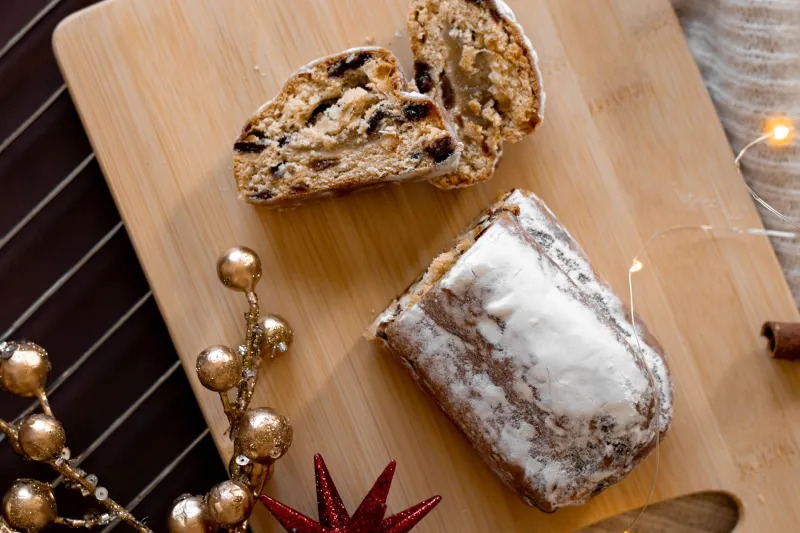
Christmas stollen has a sizing problem. Walk into any Bentham bakery or deli in November 2026 and you will find the same arrangement: one magnificent, flour-dusted monolith on the counter, flanked by a stack of modest little parcels the size of a fist. The big one gets the gasps. The small ones get bought quietly, eaten properly and, I would argue, represent the more civilised way to do Christmas.
This is not a attack on the grand stollen. A well-made large loaf is a lovely thing, and there is something enjoyably ceremonial about cutting into a proper Christmas centrepiece. But ceremony has a cost. A big stollen asks you to organise a household, commit to a slicing schedule and accept that the last third may be eaten out of duty rather than desire. A small stollen asks only that you put the kettle on.
The trouble with the grand gesture
A large stollen is often at its best on day one. By the second week it can dry at the edges, the marzipan can slump, and the icing sugar begins to look less like snow and more like dust. In a small cake, the ratio of crust to crumb is different: more surface, more sugar, more of the slightly crisp edge that makes stollen feel festive. It also stays fresher because you open one at a time rather than exposing a whole loaf to the air.
There is a social argument too. One large stollen invites negotiation. How thick should the slices be? Who gets the marzipan-heavy middle? Is it acceptable to cut a wedge for breakfast and call it brunch? A tray of individual stollen removes the committee meeting. Everyone gets their own. That is not greed; it is good manners.
What makes a good miniature
Size is only the beginning. A mini stollen should weigh somewhere between 100g and 150g, enough to feel like a treat without becoming a meal. It should look generous but not inflated. If it is the size of a satsuma and weighs almost nothing, walk on.
The first test is the marzipan. Traditional stollen does not always contain marzipan, but the best versions do, and in a miniature cake the almond paste needs to earn its place. As a rough guide, aim for marzipan at around 15–20% of the cake’s weight. In a 120g stollen, that is roughly 18–24g — enough for a proper seam of almond paste, not a rumour of one. If the label says ‘marzipan flavour’ rather than marzipan, put it down gently and back away.
The second test is the crumb. Stollen is a yeasted fruit bread, not a sponge cake. It should be close and soft, enriched with butter, and able to tear into shaggy pieces without crumbling into sawdust. A good mini stollen feels substantial in the hand. A bad one squishes into dough or shatters at the first touch. The crust should be thin and lightly dusted, not leathery. The fruit should be distributed through the dough rather than hoarded at one end like a surprise nobody wanted.
Doing the rounds in Bentham
On a damp Saturday in early November, I did the obvious thing and went looking. The first stop was a bakery counter on Main Street, where the mini stollen sat in neat rows under a glass dome. These were the traditionalists: dark with sultanas, flecked with candied peel, and with a marzipan core that ran almost end to end. The crumb was close and buttery, the sugar dusting generous. They were the sort of cakes that make a grey morning feel briefly manageable.
A deli near the bridge took a different approach. Its small stollen leaned heavily on citrus peel, with a thinner almond core and a lighter, more open crumb. Pleasant with coffee, certainly, but you noticed the missing weight. It was a stollen in the way a mince pie is a pie: technically true, but not the whole story. A third version, from a farm-shop counter out towards the fells, was the most restrained of the lot. Dense, almost biscuity at the edge, with marzipan no thicker than a pound coin. Lovely with a strong cup of tea; less convincing as a Christmas argument.
The best of the batch was not the fanciest or the most expensive. It was the one that had been baked that morning, wrapped simply, and sold with the useful warning that it would keep for a week but would not last that long in a house with a working kettle.
The marzipan question
Marzipan is where mini stollen reveals its character. In a large cake, a modest core can get lost in the middle and still satisfy. In a small one, the marzipan is either there or it is not. A good mini stollen has a visible rope of almond paste that runs through the centre without overwhelming the fruit. It should taste of almonds rather than sugar alone, and it should be soft enough to cut cleanly without pulling away from the crumb.
This is also where cheap versions fail. Too little marzipan and the cake is just a fruited bread in a festive hat. Too much and it becomes a marzipan sweet with a bread coating. The sweet spot is a generous seam: enough that each bite has a little almond richness, not so much that the fruit is forgotten.
Crumb structure, or why squish matters
A stollen should feel like it has been made with butter and time. The crumb should be tender but not cakey, with enough structure to hold the fruit and marzipan in place. When you tear one open, it should come apart in soft, uneven pieces rather than clean slices. That shagginess is a good sign. It means the dough has been enriched properly and not overworked.
Dryness is the enemy. A mini stollen that crumbles at the first cut will not improve with age. Nor will one that is so dense it sits in the stomach like a paperweight. The best versions have a slight spring to them, a buttery softness that makes you want a second one before you have finished the first. That is not a failure of willpower. It is quality control.
Buy three, not one
The case for several small cakes is not complicated. Three mini stollen let you compare. You can have a plain one, a marzipan-heavy one and a citrus-forward one, and decide which you actually prefer. You can give one away. You can keep one for Boxing Day. You can put one in the tin and forget about it until a Tuesday afternoon in December when nothing else will do.
A large stollen is a display object. A small one is a daily indulgence. In Bentham, where the Christmas lights are modest and the tea is strong, that feels about right. Buy two more than you think you need. Store them in a tin, not the fridge. Warm them briefly in a low oven if you like, but do not microwave them unless you enjoy disappointment. Then make a pot of tea and admit that the small cake was the better idea all along.
A civilised finish
The individual stollen is not a compromise. It is a correction. It gives you the fruit, the marzipan, the sugar and the butter without the pressure of a centrepiece. It suits a household of one, two or twelve. It suits a Tuesday. And in a town with more good counters than it strictly needs, that is a small Christmas miracle worth defending.